In this tutorial, we have to write a function to find first node of loop from given linked list. If the loop exists, it returns the first node in the loop. Otherwise, it returns NULL.
Example :
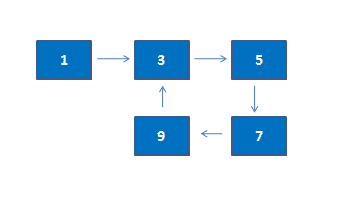
In above program, 3 is the first node of loop
Example – Program to find first node of loop in a linked list
We will use below steps to find first node of loop in a linked list.
- If a loop is found, initialize a slow pointer to head, let fast pointer be at its position.
- Move both slow and fast pointers one node at a time.
- The point at which they meet is the start of the loop.
public class LinkedListFirstLoop {

  static Node head;

  static class Node {

    int data;

    Node next;

    Node(int d) {
      data = d;
      next = null;
    }
  }

  Node detectFirstLoop(Node head) {

    if (head == null || head.next == null) {
      return null;
    }

    Node slowPtr = head;
    Node fastPtr = head;

    // Move slowPtr and fastPtr 1 and 2 steps
    slowPtr = slowPtr.next;
    fastPtr = fastPtr.next.next;

    // Search for loop
    while (fastPtr != null && fastPtr.next != null) {
      if (slowPtr == fastPtr) {
        break;
      }
      slowPtr = slowPtr.next;
      fastPtr = fastPtr.next.next;
    }

    // If loop does not exist
    if (slowPtr != fastPtr) {
      return null;
    }

    // If loop exists. Start slowPtr from head and fastPtr from meeting point.
    slowPtr = head;
    while (slowPtr != fastPtr) {
      slowPtr = slowPtr.next;
      fastPtr = fastPtr.next;
    }

    return slowPtr;

  }

  public static void main(String[] args) {
    LinkedListFirstLoop list = new LinkedListFirstLoop();
    list.head = new Node(1);
    list.head.next = new Node(3);
    list.head.next.next = new Node(5);
    list.head.next.next.next = new Node(7);
    list.head.next.next.next.next = new Node(9);

    // Creating a loop for testing
    head.next.next.next.next.next = head.next;

    Node firstNode = list.detectFirstLoop(head);

    if (firstNode== null) {
      System.out.println("No loop found");

    } else {
      System.out.println("First loop node is : " + firstNode.data);
    }

  }
}
Output:
First loop node is : 3
